

Using Story Points Effectively: How Agile Teams Truly Understand Effort
02.02.2026

What Are Story Points in Agile Project Management?
Story Points are a relative unit of measurement with which agile teams assess the complexity, risk, and thus the effort of a task (User Story). They replace time estimates in hours or days and enable realistic, comparable, and person-independent effort estimation within Scrum or Kanban teams. Story Points promote team dialogue, prevent miscalculations, and form the basis for Team Velocity, i.e., the amount of work completed per iteration.
This definition is easy to understand—the implementation, however, is rarely trivial. In our projects, we repeatedly experience that the handling of Story Points reveals much about the understanding of agility. Many project managers know this: The effort estimate is in place, yet reality looks quite different. In traditional projects, planning is meticulous in hours and days—often with the expectation of predicting everything precisely. In practice, this rarely leads to certainty, but rather to disappointment.
Agile methods turn this approach on its head. Instead of defining everything in advance, only what is currently most important is estimated: the features with the highest customer value. These are broken down into User Stories and implemented step by step. This creates planability, flexibility—and genuine learning cycles.
The question is therefore no longer: How long will the entire project take?
But rather: How much value can we deliver in the next iteration?
From Project Plan to Feature Backlog: Priorities Instead of Perfection
In the agile environment, the Feature Backlog serves as a dynamic roadmap. Each feature is a function with recognizable value for the customer. The backlog is prioritized: At the top are the topics that carry the greatest value or the greatest risk. A realistic estimate of the top features is doubly valuable:
- It makes release planning and roadmapping possible.
- It helps weigh effort against value.
Practical Tip:
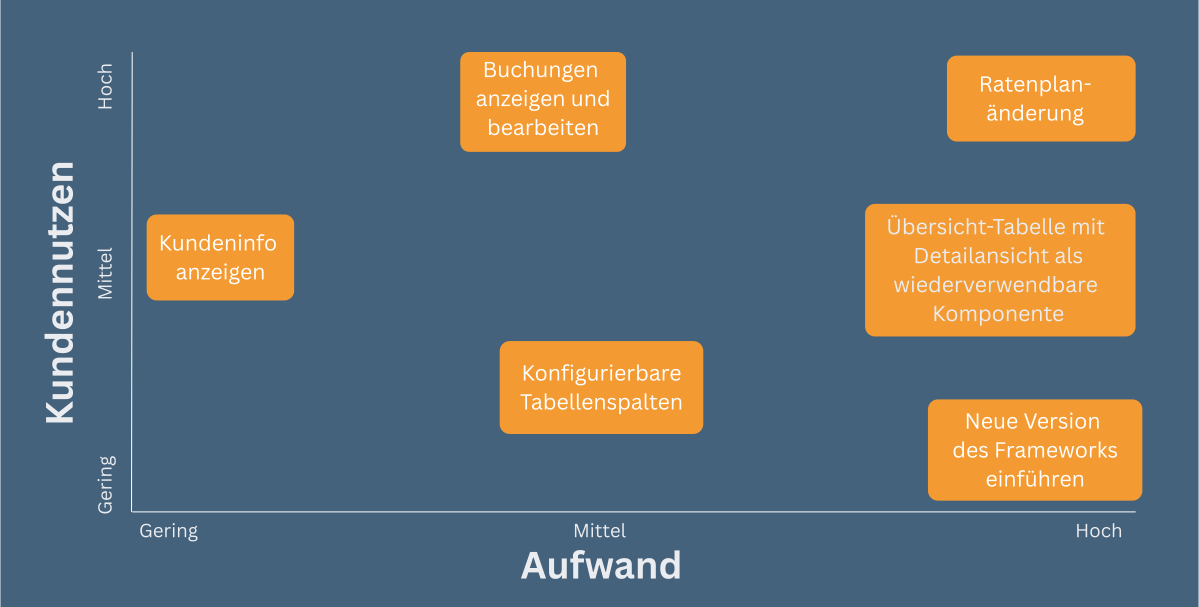
In S&N Group projects, teams frequently use a simple matrix: customer value vs. effort (in Story Points). This allows features to be prioritized transparently—and quick wins to be implemented faster.
From Features to Stories: Small Units, Clear Results
Before a feature is implemented, it is broken down into smaller stories—work packages that can be completed within one iteration (e.g., a Scrum Sprint). This approach creates transparency and measurability: Each story is a small, finished result. After each sprint, the team can show what has been created—and incorporate customer feedback directly. This is precisely where estimation with Story Points comes into play. Each story is estimated as part of a Planning Poker session.
Why Time Is Not a Good Measure
Time estimates appear precise but are deceptive. Whether a task takes two or five days depends on many unpredictable factors:
- Who will ultimately implement it?
- What obstacles will arise?
- How smoothly will collaboration proceed?
These factors do not influence estimation with Story Points. In agile teams, it is not about hours, but about complexity, uncertainty, and effort. This is the core of Story Points. The following example shows what impact missing or misunderstood estimates can have in practice:
Experience from a Client Project
In a project in the banking sector, the team worked with User Stories and fixed sprint lengths but deliberately refrained from any form of effort estimation. The motivation behind this was understandable: Within the team, there was concern that estimates would later be used for performance evaluation. In practice, however, this approach led to a different problem. Since it remained unclear how much work realistically fit into a sprint, approximately 90% of the planned stories could not be completed and regularly carried over to the next sprint.
When the team agreed to introduce Story Points on a trial basis, the discussion in Planning Poker shifted. Instead of talking about time, the question increasingly centered on whether a story could be meaningfully implemented within the sprint length at all. Many stories were subsequently broken down into smaller pieces or restructured. The result: After a short time, the completion rate rose to over 90%. In place of frustration over unfinished work came visible results and a tangible sense of achievement within the team.
This example shows that Story Points do not serve as a control mechanism but help structure work realistically and make it plannable.
Story Points: Making Effort Visible
Story Points do not measure time required but the relative effort of a story.
Teams estimate together how complex or risky a task is compared to others. A common tool is the Fibonacci scale (1, 2, 3, 5, 8, 13, 21). The growing distance between the numbers expresses the increasing uncertainty with large tasks.
Example from Practice
- 2 Points: Small, clearly defined task (e.g., add button).
- 5 Points: Medium-sized story with dependencies (e.g., form with validation).
- 13 Points: Complex topic with unclear interface or new framework.
Experience from Practice: What Often Goes Wrong
Many teams introduce Story Points—and experience frustration. Why? Because they try to convert them into hours. This destroys the actual purpose: relative comparability and independence from individuals.
Common Pitfalls
- Story Points misused as a performance metric: Velocity becomes a KPI—this creates pressure instead of trust.
- Estimates without references: Without examples from the past, every team remains uncertain.
- Stories that are too large: If a story is too large, no point value helps—it must be split.
Insight into Practice
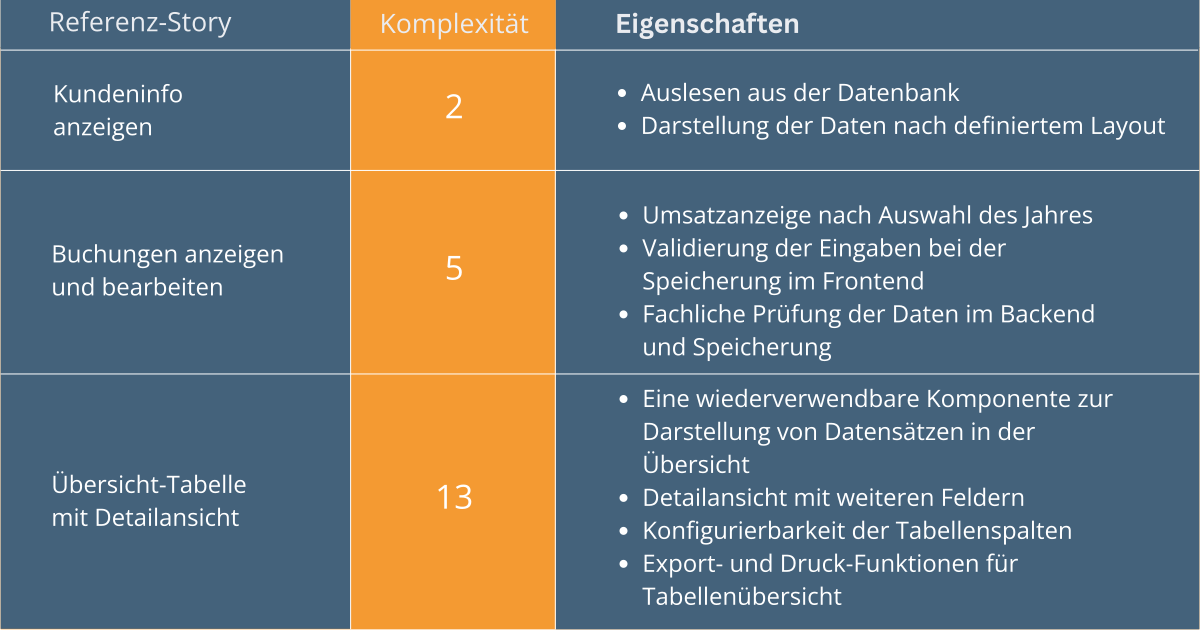
At S&N Group, teams usually begin with a “Baseline Story”—a small, known task with a fixed 2 points. Everything else is estimated in comparison to it. After a few sprints, a common language for effort emerges. In a client project, we created a reference story table that characterizes exemplary stories from previous sprints and contains a complexity rating. The complexity was estimated by developers before a sprint and validated after the sprint to determine whether the estimate was accurate. In subsequent sprints, we use these reference stories to estimate new stories with similar characteristics. The following table shows exemplary reference stories from an S&N client project.
Team Velocity: Learning from Experience
After several iterations, it becomes apparent how many Story Points a team implements on average—the so-called Velocity. It is not an evaluation but an empirical value:
How much can this team accomplish in this context per iteration?
Velocity stabilizes after several sprints and becomes the basis for realistic planning and forecasting.
However: It must not be misunderstood as a target metric. A team that artificially increases its Velocity loses focus on quality and customer value.
How Do You Estimate with Story Points? Our Best Practices.
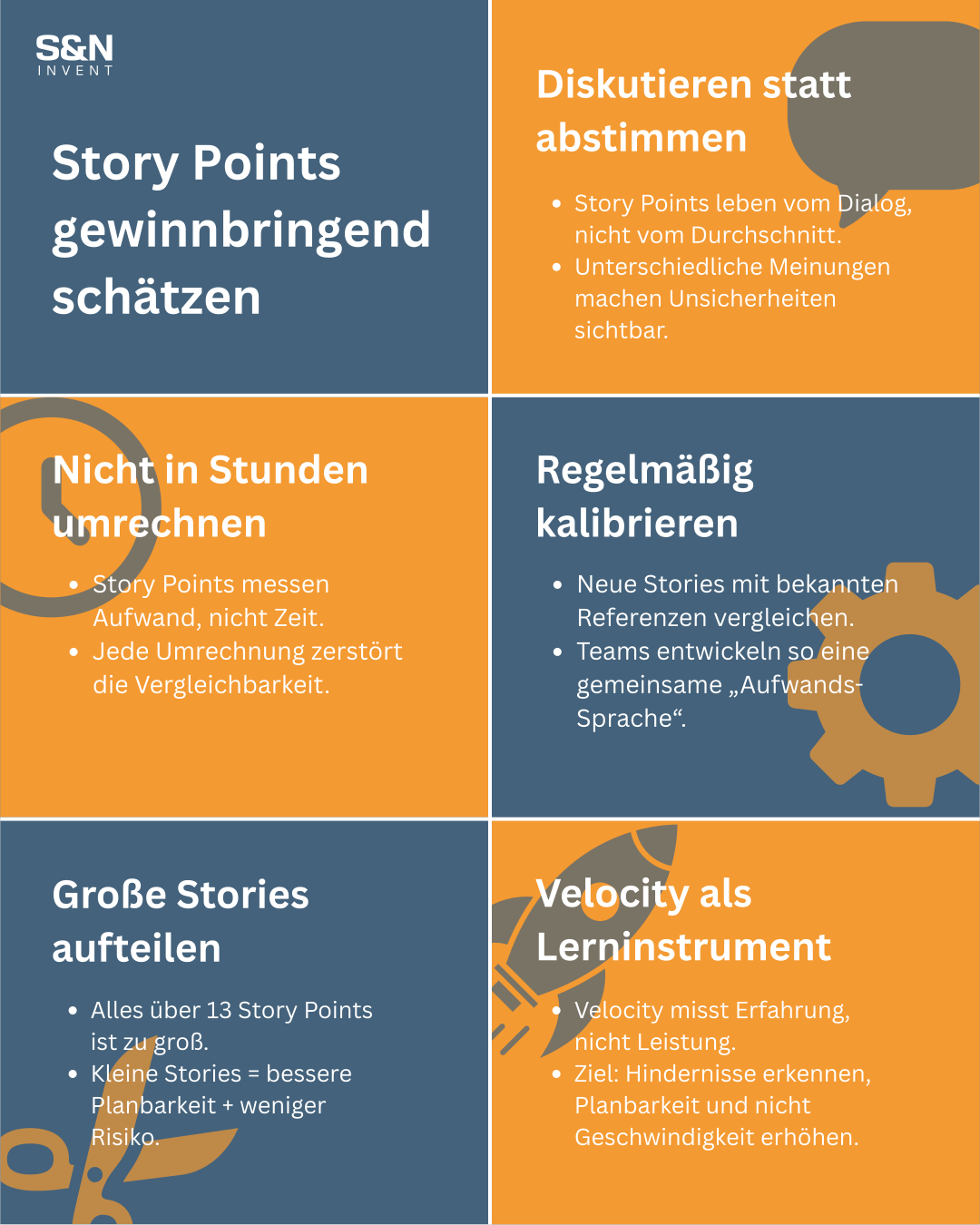
- Discussion instead of voting: Estimation is a learning process—differing assessments are valuable.
- No conversion into hours: This contradicts agile thinking.
- Calibrate regularly: Compare new stories with old references.
- Split large stories: Anything over 13 points should be broken down.
- Understand Velocity as a learning tool: Not: “How fast are we?” but rather: “What is hindering us?”
Benefits in Daily Practice
- More realistic planning: Teams plan with empirical values, not wishful thinking.
- Better prioritization: Effort and value become comparable.
- Greater transparency: Customers and stakeholders see progress in understandable form.
- Team understanding grows: Collaborative estimation promotes communication and trust.
Conclusion: Story Points Are Not a Goal—They Are a Tool for Learning
Story Points are more than an estimation method. They are a communication tool.
“Story Points promote discussion instead of illusion. Collaborative estimation creates understanding within the team—often more valuable than the number itself.”
Jürgen Tacken
Story Points create a shared understanding of effort, promote dialogue, and enable continuous improvement. Teams that use Story Points effectively gain planning reliability without losing their agility. How we apply agile estimation methods even in traditional projects will be covered in an upcoming blog article. Stay tuned!
Speak with Our Experts
Would you like to introduce Story Points in your project environment or professionalize your agile planning? S&N Group supports you with many years of experience from agile software projects, coaching, and transformations.
About the Authors
The S&N Group supports companies in the introduction of agile methods, in digital transformations, and in demanding software projects. Our experts combine technological excellence with agile implementation experience from over 35 years of project practice—with the goal of creating sustainable solutions that truly work in everyday operations.

Dr. Jürgen Tacken has supported numerous S&N Group clients as Scrum Master and agile coach. His passion is to enable teams so that agile methods deliver genuine value—and do not merely exist on paper. The focus is on effective collaboration, clear communication, and a working approach that promotes motivation, trust, and successful project outcomes.

Dr. Baris Güldali is a methodology expert for traditional and agile software development. His focus areas lie in agile transformation and continuous quality assurance. At the center of his work are the communication of suitable methods, their practical application, and the sustainable enablement of project teams. His in-depth knowledge is based on extensive practical experience in quality management as well as diverse research activities. Furthermore, he is broadly networked as a member of the steering committee of the specialist group Test, Analysis and Verification of Software (TAV) of the German Informatics Society.
Did you enjoy this post? Feel free to share it with others.